

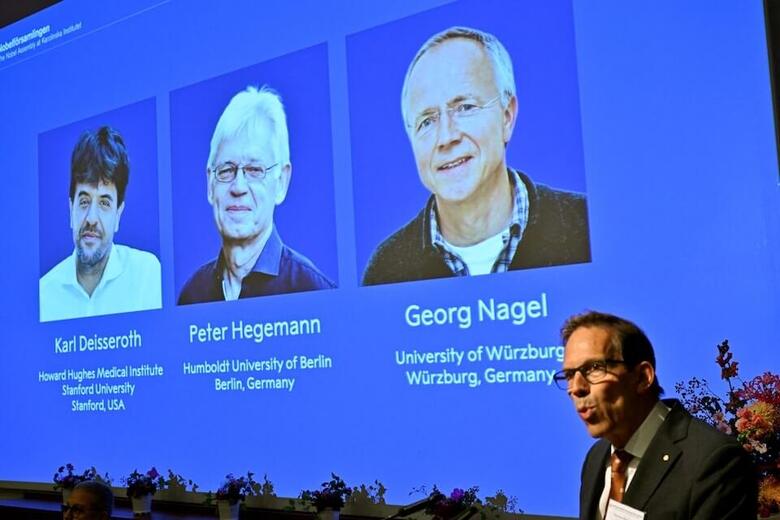
2026年諾貝爾醫學獎頒給美國學者戴瑟羅斯及德國科學家赫吉曼和內格爾。(路透社)
(中央社斯德哥爾摩5日綜合外電)2026年諾貝爾醫學獎5日頒給美國學者戴瑟羅斯及德國科學家赫吉曼和內格爾,以表彰他們在光控離子通道與光遺傳學領域的發現。
戴瑟羅斯(Karl Deisseroth)現年54歲,在美國霍華休斯醫學中心(Howard Hughes Medical Institute)暨史丹佛大學(Stanford University)任職;赫吉曼(Peter Hegemann)今年71歲,為德國柏林洪堡大學(Humboldt University of Berlin)學者;現年73歲的內格爾(Georg Nagel)則是德國烏茲堡大學(University of Würzburg)教授。
根據諾貝爾獎(Nobel Prize)官網,2026年諾貝爾生理學或醫學獎表彰光遺傳學(optogenetics)領域的研究,這項方法能揭示神經細胞如何在活體腦中形成記憶、情緒與行為。
赫吉曼與內格爾在一種單細胞藻類中,發現一種特殊蛋白質,名為光敏感通道蛋白(channelrhodopsin)。戴瑟羅斯則將這種蛋白質轉化成能以光控制神經細胞的開關。3名得主為神經科學新時代奠定基礎。
長久以來,大腦如何支配情緒、行為和身體功能一直是個謎,20世紀,研究人員開始探究大腦哪些區域影響哪些功能,但當時使用的方法無法證明兩者之間的因果關係。他們當時建立的大腦圖像就像一張草圖,充滿問號與未知。如今,這一切正在改變。
赫吉曼的好奇心揭開了這項研究的序幕。他想弄清楚單細胞藻類衣藻(Chlamydomonas)究竟如何朝著光源游動。2000年代初期,他與內格爾發現光敏感通道蛋白,這是一種具有獨特特性的藻類蛋白質,存在於細胞表面。
當受到藍光照射時,這種蛋白質會開啟一個通道,帶電離子接著流入細胞,形成電脈衝。他們發現,不論將這種蛋白質放入哪一種細胞,那些細胞都會變得對光敏感。
Peter Hegemann and Georg Nagel – awarded the 2026 medicine prize – discovered a remarkable protein, channelrhodopsin, in a single-celled alga. Hegemann wondered how Chlamydomonas, a single-celled alga, is able to swim towards a light source. In the early 2000s, he and Georg Nagel discovered channelrhodopsin, an algal protein with unique properties, found on the surface of the cell. When it is illuminated by blue light, a channel opens through the protein. Charged ions then flow into the cell, creating an electrical impulse. They found that regardless of which cell they put the protein in, those cells became light sensitive. #NobelPrize
— The Nobel Prize (@NobelPrize) October 5, 2026
戴瑟羅斯將光敏感通道蛋白基因導入老鼠的神經細胞。透過以藍光照射這些細胞,他得以觸發神經訊號。他2005年發表這項突破性成果。兩年後,他讓這種受光控制的神經細胞開關在活體老鼠腦中發揮作用。
This year’s medicine laureate Karl Deisseroth transformed the protein channelrhodopsin into a light-controlled switch for nerve cells. Deisseroth introduced the gene for channelrhodopsin into nerve cells from rats. By illuminating the cells with blue light, he was able to trigger a nerve signal. He published this breakthrough in 2005. Two years later, he made this light-controlled switch for nerve cells work in the brains of living mice. #NobelPrize
— The Nobel Prize (@NobelPrize) October 5, 2026
這種利用光線控制神經訊號的方法現稱為光遺傳學,已迅速在全球產生影響。透過光遺傳學,研究人員得以揭示與神經及精神疾病相關、掌控特定記憶、情感與行為的神經迴路。在臨床醫學,研究人員正運用這項方法,嘗試讓視力受損者恢復視力。
法新社報導,這個領域有助研究人員了解特定細胞類型如何影響學習、恐懼、成癮和運動等行為,未來可能進一步促成治療巴金森氏症(Parkinson's Disease)與癲癇等神經及感覺障礙的方法。
諾貝爾生理學或醫學獎委員會主席斯文寧松(Per Svenningsson)表示:「光遺傳學為繪製大腦圖譜提供機會,而這種方式過去只能是我們的夢想。」
今年首個諾貝爾獎項醫學獎5日在瑞典公布,接著將於6日頒發物理獎,7日揭曉化學獎,8日公布文學獎。
備受矚目的和平獎是唯一在挪威奧斯陸(Oslo)頒發的獎項,將於9日揭曉;經濟學獎將於12日公布。
諾貝爾獎基金會(The Nobel Foundation)上月宣布,每一獎項的獎金將從去年的1100萬瑞典克朗提高至1200萬瑞典克朗(約新台幣3800萬元)。若有數名得獎者共享獎項,他們將分享獎金。